

Today’s uncertain digital-first world means that cyber threats are no longer a matter of if they will happen, but a matter of when. From ransomware attacks that lock up your data to system failures that halt operations, the reality is that disruptions happen. The real question is: Are you prepared to respond and recover quickly?
There’s a line from a song (I think): “Hoping for the best but expecting the worst.” Sounds negative, yeah? What I mean to say is “Be prepared.” As an organization, you should be ready for everything.
You may be wondering what cybersecurity has to do with preparedness. How are we involved in something that appears non-technical? Well, we concern ourselves with every aspect of your business. We ensure you succeed.
In cybersecurity, we have a term for uninterrupted organizational operations: Business Continuity. This is how we ensure that if any of the scary security breaches and natural (and country-based) disasters occur, it is business as usual. This plan also covers your needs for upscaling and handling increased business. In addition, we have an incident response plan that ensures, as the business continues, we are doing all we can to minimize damages. Awesome, yeah? I know. Let’s consider some of these disruptions and their consequences.
Daily Disruptions: What They Look Like
In November 2017, the popular medical drama Grey’s Anatomy aired a “cyberattack” episode. That was my first exposure to how a cyberattack happens and the resulting panic and destabilization. Threat actors accessed the hospital network, locked the hospital staff out, and posted a message on every screen demanding a ransom. The doctors had no access to patient charts, drug records, and test results. As the doctors now used probes for non-invasive techniques, and the threat actors were tampering with even the air conditioner, those in the operating rooms were also affected. Luckily, one of the doctors had cybersecurity experience and hacked them back. Happy ending, but could they have done more? Is there a way that the hospital could have continued running even during the attack?
Consider this: Let’s say you own an online shopping platform. You have everything set for your Black Friday sales. You have even paid for online promotions and advertisements, and have estimated a triple increase in your regular site traffic. You have even hired additional staff to ensure complaints are handled swiftly. Are you forgetting anything? What have you done to ensure your organization’s website can handle the increased traffic?
Maybe you are the head of operations at a multinational company, and they have elected to celebrate the company’s 25th anniversary at the office in Africa. Your region has an uncertain power supply and unpredictable weather conditions. How do you ensure everything runs smoothly?
The three scenarios above: ransomware attack, expecting increased business, and preparing for a major event, may seem unconnected, but the thing is, in all these instances, or instances like them, business operations need to remain uninterrupted.
Let’s say the ransomware attack happens, but you have backups. Or your website slows or crashes because you have increased traffic (good or bad), but you easily reroute customers to a backup site. A major server goes offline? You already have another that takes over smoothly. A thunderstorm downed electric lines, but you have generators ready to power prioritized equipment. Sounds good, yeah? Don’t just take my word for it yet. Let’s see how these tested and trusted techniques have been used.
From Plan to Practice: Business Continuity at Work
Ever heard of Victoria’s Secret (the popular lingerie brand)? In May 2025, threat actors gained access to their systems. Luckily, they had a plan for just this scenario, and their plan worked effectively. Within hours of detecting the intruders, they shut down their corporate systems and the US website to contain the breach. Furthermore, they called in experts to investigate and remediate. Ultimately, the major occurrence was a delay in releasing their first-quarter earnings report. Despite disruptions, the company successfully restored most functions and continued operations, demonstrating effective business continuity planning and incident response. Kudos to Victoria’s Secret.
In May 2025, an employee of Ascension (a major US Healthcare provider) inadvertently downloaded a malicious file (A social engineering attack; read all about it here: How Social Engineering Outsmarts the Smartest of Us). This download initiated a ransomware attack, compromising normal processes. Luckily, they had a business continuity plan, which they simply implemented. Based on their plan, they:
- Immediately shut down certain devices and systems to prevent further spread.
- Transitioned to manual record-keeping and paused some non-emergent procedures.
- Engaged cybersecurity experts to assess the breach and its impact
Although the attack impacted their electronic health records system and other critical operations, their planning and prompt implementation mitigated further damage. It is fun and extremely satisfying when the best is made of a bad situation.
Another instance where the effectiveness of business continuity strategies was highlighted was in late November 2024. Krispy Kreme (A multinational doughnut and coffee shop chain) experienced a cyberattack that disrupted its online ordering system during a peak promotional period. What they did was to immediately launch their business continuity plan that involved rerouting business to physical stores. They then called in experts to remediate the situation, as stated by their incident response plan, and came out looking good, especially as their revenue was not impacted in any way.
Now that we have explored these applications, let us get technical.
Understanding Business Continuity Planning
What is Business Continuity?
Business Continuity is any strategic and logistical planning that ensures a company can continue critical operations during and after a disruption. Such disruptions can be a cyberattack, a natural disaster, or a system failure. Business continuity focuses on:
- Minimizing downtime
- Maintaining essential services
- Protecting reputation and revenue
Business Continuity Constituents
- The Business Continuity Plan: A documented strategy outlining how business functions are maintained during adverse events. Ascension switched to paper charts, and Krispy Kreme routed traffic to physical stores. That’s implementing their business continuity plan.
- The Disaster Recovery (DR): This is a subset of BC focused specifically on restoring IT systems and data after an adverse event occurs. Remember how those companies we talked about called in experts? That falls under the disaster recovery umbrella.
Business Continuity ensures the business remains uninterrupted, or at least, critical infrastructure systems are still available. Simply put, business continuity ensures that even if an attack occurs, you can still serve customers.
What Is Business Continuity Planning?
Business Continuity Planning (BCP) is proactively preparing your organization to continue operations during and after a disruptive event. At its core, BCP answers one vital question: “How will we keep our business running if something goes wrong?”
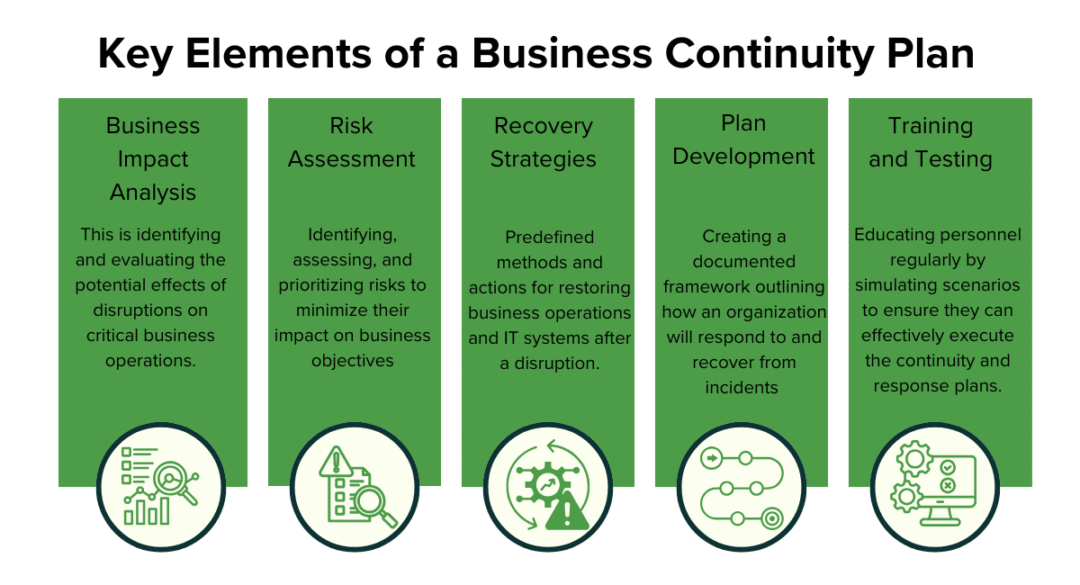
Now that we are familiar with Business Continuity, let’s look at its counterpart, Incident Response.
Understanding Incident Response
What is Incident Response?
Incident Response is a structured approach to detecting, managing, and recovering from cybersecurity incidents, such as data breaches, malware infections, or unauthorized access. It is reacting quickly, efficiently, and smartly, with minimal damage from an incident. Incident Response is what keeps businesses from spiraling into a disaster. It focuses on:
- Rapid detection
- Damage control
- Root cause analysis
- Recovery and improvement
Incident Response Components:
- The Incident Response Plan (IRP): A guide that defines roles, responsibilities, communication procedures, and step-by-step actions for responding to incidents.
- The Incident Response Team (IRT): Specialists trained to handle security events effectively.

IR involves tackling what caused the interruption. Note that IR is mainly for cybersecurity incidents. While IR deals with the “what happened?” during an attack, BC answers the “how do we keep going?”
Conclusion: Are You Prepared?
Now, you can take my word for it: Business Continuity and Incident Response have saved businesses from embarrassment and financial loss. Cyber resilience isn’t about preventing every single threat. It’s about how fast and effectively you respond when something goes wrong. If you ask yourself the question, “If something happened today, would my business keep running smoothly? Would we recover fast?” and the answer is “no” or “I’m not sure,” then it’s time to prioritize BC and IR. Wouldn’t you want your business to be one of those that sail smoothly irrespective of external fluctuations? I sure would. Now is the time to ensure you are prepared for whatever happens. To be forewarned, they say, is to be forearmed.
Email us at info@hacktales.com to help set up Business Continuity and Incident Response plans for your organization.
